

As an Amazon Associate, this website earns from qualifying purchases.
It’s no coincidence that white oak kitchen cabinets are becoming a staple in modern design, offering a blend of style and functionality. You can transform your space by embracing two-tone cabinetry, balancing matte and glossy finishes, and integrating open shelving. Careful selection of streamlined hardware and a harmonious color palette will elevate your kitchen’s elegance. As you explore layered lighting techniques, you’ll uncover how these choices create depth and warmth in your home.
1. Embracing Two-Tone Cabinetry
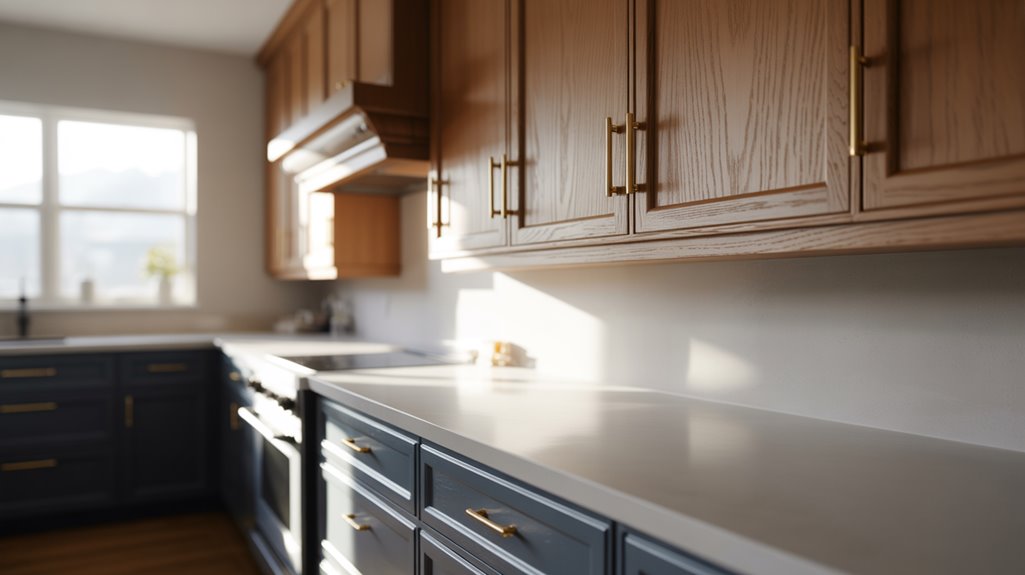
When you’re looking to elevate your kitchen design, embracing two-tone cabinetry is a surefire way to make a stylish impact. Pairing white upper cabinets with white oak lower cabinets or islands in your white kitchen effortlessly draws the eye upward and anchors the space.
This combination retains brightness while white oak’s warmth prevents an all-white scheme from feeling sterile. Opt for rift- or quarter-sawn white oak for its dimensional stability and refined linear grain, ideal for humid kitchen environments.
Choose warmer whites with cream or ivory undertones for painted components, harmonizing with oak’s natural tones. Complement with cohesive hardware like matte black or brushed brass to tie the look together, ensuring your kitchen feels both cohesive and inviting.
2. Balancing Matte and Glossy Finishes

Often, achieving a dynamic kitchen design involves skillfully balancing matte and glossy finishes. Pair matte white oak kitchen cabinets, which hide fingerprints and showcase grain textures, with a high-gloss white quartz countertop to enhance brightness and tactile contrast.
Use a satin or semi-gloss catalyzed 2K water-based topcoat on oak for durability and moisture resistance, while reserving high-gloss for accents like island end panels. Balance matte cabinetry with glossy backsplashes to reflect light into work zones, ensuring a gloss differential of two levels for distinct surfaces.
Test samples in your kitchen’s lighting; matte absorbs light, altering color perception, while gloss highlights reflections. Coordinate hardware finishes like matte black or polished chrome to complement your chosen sheen and unify the space.
3. Integrating Open Shelving for Display

Transform your kitchen’s aesthetic by integrating open shelving for both practicality and style. Position open oak shelves between white upper cabinets and the countertop in your white oak kitchen. This setup introduces natural texture while keeping essentials within reach. Limit shelf depth to 10–12 inches and install them 12–18 inches above the countertop for comfortable display and unobstructed workspace. Make sure the shelf material and finish match your lower cabinetry for cohesion.
Enhance your display with integrated LED strip lighting to highlight pieces and eliminate shadows. Style with a mix of functional and decorative items in odd-number groupings to maintain balance. Here’s how:
| Function | Item | Placement |
|---|---|---|
| Storage | Plates, Glassware | Center |
| Decor | Potted Greenery | Ends |
| Accent | Framed Art, Bowl | Middle |
4. Selecting Streamlined Hardware

While open shelving adds flair to your white oak kitchen, selecting streamlined hardware enhances its modern elegance. Choose hardware proportions that align with your oak kitchen cabinets’ door style—opt for 8–12″ pulls on islands and drawers, and 3–6″ pulls or 1–3″ knobs for standard doors. This maintains the clean lines of flat-panel white oak.
Prefer low-profile finishes like matte black or brushed brass to contrast without overshadowing the oak’s grain texture. Linear, slim bar pulls or recessed options add a minimalist appeal, especially when working with rift or quarter-sawn oak.
Make sure your mounting matches common European spacings for a consistent look. Finally, specify durable finishes and fasteners to withstand humid, high-touch environments, ensuring long-lasting performance.
5. Harmonizing Color Palettes
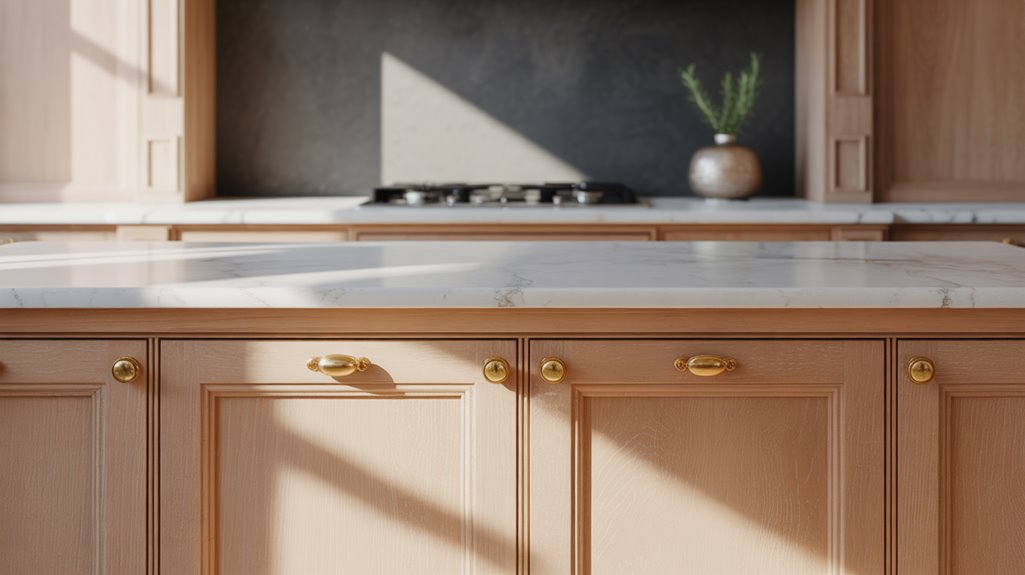
When harmonizing color palettes with white oak kitchen cabinets, consider how different hues interact with the oak’s natural warmth. Opt for warmer whites like cream or ivory to complement the oak kitchen’s golden tones. Two-tone schemes with white uppers and oak lowers can balance brightness and warmth. Incorporate muted natural accents—such as sage green or warm greige—to harmonize with the oak’s undertones. For a touch of drama, introduce deep accents in hardware or an island face, but limit these to maintain cohesion. Always test samples in your kitchen’s lighting to see how the colors and oak tones play together.
- Pair warm whites with oak’s golden grain.
- Balance with two-tone schemes.
- Use muted natural accent colors.
- Introduce limited deep accents.
- Test all elements in varied lighting.
6. Implementing Layered Lighting Techniques
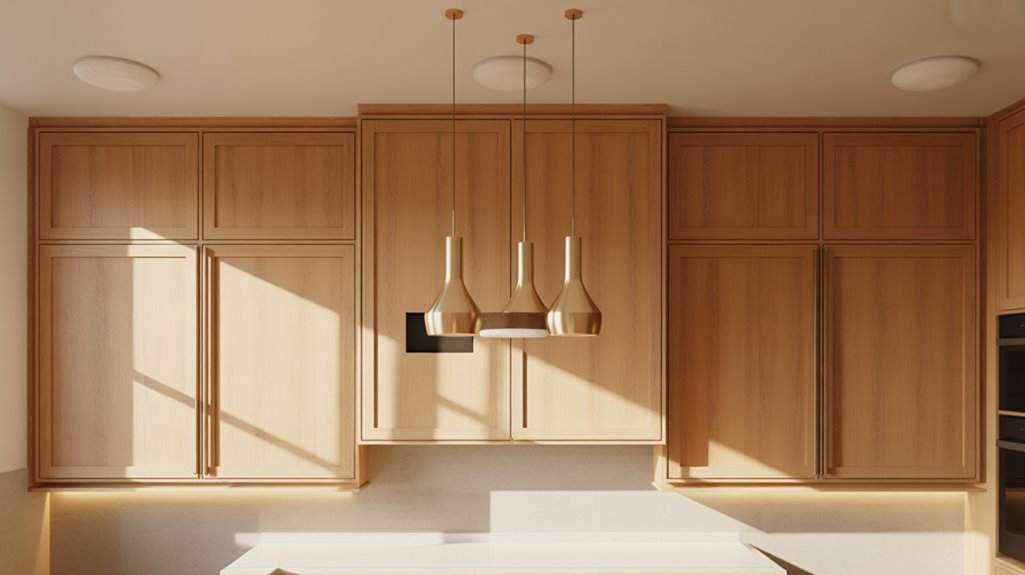
After harmonizing your color palette with the inviting warmth of white oak kitchen cabinets, it’s time to focus on how lighting can enhance your space. Layered lighting is essential to showcase the stunning grain of honey oak kitchen cabinets. Start with ambient lighting using ceiling fixtures at 3000–3500K for a soft, inviting glow. Under-cabinet LED strips provide task lighting, mounted 2–4 inches back to reduce glare and highlight the natural beauty of oak.
| Lighting Type | Placement | Purpose |
|---|---|---|
| Ambient | Ceiling fixtures | General illumination |
| Task | Under-cabinet LEDs | Focused light on work surfaces |
| Accent | Directional LEDs or pucks | Highlight oak grain, add visual interest |
Pendant lights over islands and toe-kick RGB strips add depth and elegance. Utilize dimmable drivers for flexibility.