
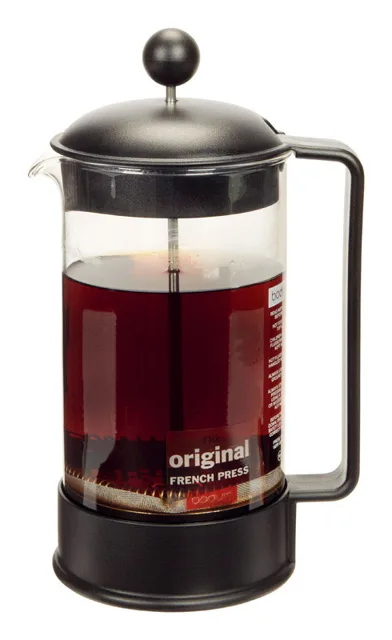
Bodum Brazil 34 oz French Press Review
We may earn a commission from some links on this page.
The Bodum Brazil 34 oz French Press is the plain version of a very old idea: a glass beaker, a mesh plunger and a plastic frame holding the two together. There is no second filter inside and no locking collar, just a three-part stainless steel mesh and a lid that keeps liquid from splashing while you press. What it does offer is capacity, a 34-ounce carafe close to a full litre, in a design Bodum still sells. Whether that suits your counter is mostly a question of how many cups you pour at once.
Key Takeaways
- 34-ounce carafe, close to a litre, so one press fills several mugs.
- Three-part stainless steel mesh filter, with no paper filter to buy.
- Borosilicate glass carafe with a BPA-free plastic handle and base.
- A measuring spoon is included and the parts are dishwasher safe.
- The mesh alone will not stop fine sediment reaching the cup.
Simple Build, Few Parts
The Brazil is made from three materials, and each one does a single job. The carafe is borosilicate glass, the heat-resistant glass used for laboratory ware, so it takes boiling water and the cool-down afterwards without the brittleness of ordinary glass. The frame around it is BPA-free black plastic, with the handle and the base both made of it.
Fewer parts also means fewer places for a press to fail. There is no hinge, no spring valve and no locking ring to lose. The plunger rides on a stainless steel rod, the filter sits at its base, and the lid presses straight on top.
Cleaning follows the same logic. The parts are dishwasher safe, and the mesh needs a rinse under the tap after each brew because coffee oils cling to it. Skip that and the oils go rancid in the filter and taste of it in the next pot.
How It Brews
Brewing is a four-minute job with nothing to program. You add coarse grounds, pour water just off the boil, wait, then press slowly and pour the whole pot out. The mesh lets the coffee's oils and fine particles through, which is the point of a press: you taste more of the bean than a paper filter allows, and the same particles settle at the bottom of the cup, so the last mouthful is grittier than the first.
Capacity is where the 34-ounce size earns its space. Measured in the four-ounce cups Bodum uses, the carafe is built to fill a table rather than a single mug, and a press works best when it is at least half full, because a shallow bed of grounds is harder to press evenly. If you drink one cup in the morning, this is more coffee than you need, and the 12-ounce Brazil is the same press without the waste.
| Feature | What it means in use |
|---|---|
| 34-ounce capacity | One press fills several mugs |
| Three-part mesh filter | Oils reach the cup, no paper to buy |
| Borosilicate glass | Takes boiling water without cracking |
| Plastic handle and base | BPA-free plastic |
Detailed Features
The Brazil is a fixed design rather than a configurable one, so what you see is what you brew with. The specifications are worth reading once, because two of them decide whether the press suits you: the capacity and the filter.
| Specification | Detail |
|---|---|
| Model | 1548-01US |
| Capacity | 34 ounces, about a litre |
| Carafe | Borosilicate glass |
| Filter | Three-part stainless steel mesh |
| Handle and base | BPA-free black plastic |
| In the box | Press and coffee measuring spoon |
| Cleaning | Dishwasher safe parts |
Nothing in that list is a feature you have to learn or a setting you have to hold: the Bodum Brazil 34 oz has one moving part and no settings at all.
Advantages and Disadvantages Overview
The case for the Brazil is capacity and simplicity, and the case against it is everything that comes with a mesh filter. It holds enough for a table, it has almost nothing that can break and it goes in the dishwasher. It also puts sediment in the cup, it does not keep coffee warm, and it is the wrong size for one person. None of those are faults exactly; they are the trade the design makes.
| Advantages | Disadvantages |
|---|---|
| Large capacity | Sediment in the cup |
| Simple mechanism | Glass can break |
| Dishwasher safe | No insulation |
| Measuring spoon included | Needs a coarse grind |
Who It Suits
This press suits a household that drinks coffee in rounds. Two or three people at a breakfast table, or one person who takes a flask to work, will pour the full carafe in one sitting. It also suits anyone who wants a press they can take apart and clean without hunting for a special brush, and anyone who would rather replace a mesh filter than a whole brewer.
It suits a single-cup drinker far less. The volume is the reason to buy it, so if you rarely finish a pot, the capacity becomes waste and the coarse grind becomes an extra step for coffee you throw away. A smaller press does the same job with less to pour out.
Either way, plan on a burr grinder. A blade grinder produces a mix of dust and chunks, the dust slips through the mesh and the chunks stay dry in the middle, and no amount of pressing fixes either. The Brazil rewards an even, coarse grind more than it rewards any other part of the routine.
Frequently Asked Questions
Does the Bodum Brazil 34 oz French Press make gritty coffee?
It leaves more sediment than a paper filter because the mesh is the only filter in the path. Most of it settles at the bottom of the carafe, and pouring slowly, without tipping the last of the pot, keeps it out of the cup.
Is the 34-ounce size too big for one person?
For a single mug, yes. The carafe is meant to fill a table, and Bodum sells the same press in a 12-ounce size for one serving. The 34-ounce model is worth it only if you regularly pour more than one cup.
What model number is the press?
The product page lists it as model 1548-01US, in the 34-ounce size. That is the reference to quote if you look it up again.
What grind should I use in it?
Coarse, roughly the texture of sea salt. A finer grind passes through the mesh and leaves sludge in the cup, and it also makes the plunger hard to push down evenly.
Does it keep coffee hot?
No. The glass carafe holds heat while the press stands, but it has no insulation, so coffee is at its best within the first half hour. Pour what you are drinking and leave the rest in the pot rather than over the grounds.