
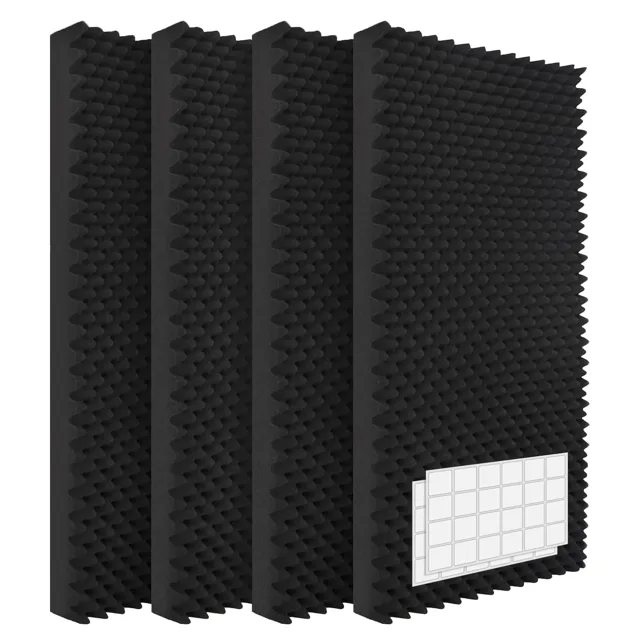
Garvee 4 Pack Acoustic Panels Review
We may earn a commission from some links on this page.
The Garvee 4 Pack Acoustic Panels are foam wall panels sold for cutting echo in bedrooms, studios and offices. The maker lists a 2-inch thickness, an egg-crate surface and a self-adhesive backing, which puts them in the peel-and-stick category rather than the framed-panel one. They are a foam product, not a dense fiberglass board, so they suit a wall you want to cover quickly and cheaply. This review sets out what the maker states about the panels, how they go up, and where foam stops being the right answer.
In this review
- Foam Panels Built for Wall Absorption
- Peel-and-Stick Installation
- Detailed Features
- Advantages and Disadvantages Overview
- Where These Panels Fit
- Frequently Asked Questions
Key Takeaways
- The panels are 47.2 by 23.6 by 2 inches, in high-density polyurethane foam.
- An egg-crate surface is designed to break up reflections rather than leave a flat face.
- The maker lists the foam as fire-resistant, odor-free and non-toxic.
- Adhesive stickers are included, so the panels go up without drilling.
- They ship vacuum-packed and need 24 to 48 hours in a ventilated room to reach full shape.
- Foam of this kind softens mid and high frequencies; it is not a bass trap.
Foam Panels Built for Wall Absorption
Garvee describes these as sound dampening panels for a bedroom, media room or studio. The working part is the surface: the egg-crate pattern gives the foam a textured face, which the maker says extends the path of a sound wave so more of it is absorbed instead of bouncing straight back.
Each panel measures 47.2 by 23.6 inches and is 2 inches thick, so a single panel covers a strip roughly four feet long and two feet wide. The material is a high-density polyurethane foam. Garvee lists it as fire-resistant, odor-free and non-toxic, and describes the panels as tough enough for long-term use with little upkeep.
That combination suits a room with hard walls, a bare floor and a lot of glass, where clapping produces a ringing tail. A layer of foam on one or two walls takes the edge off that reflection. It does not block sound from passing through a wall, and it will not tame a deep boom from a subwoofer; that job needs thicker, denser treatment in a corner.
Peel-and-Stick Installation
The set includes adhesive stickers, and Garvee describes the install as peel and stick with no drilling and no extra equipment. The maker's guidance is to start with a wall that is clean and dry, then press the stickers into place.
Two practical points come out of that. First, an adhesive pad on painted drywall is a semi-permanent fixing: pulling a panel off later can take paint with it, so plan the arrangement before the first panel goes up. Second, the maker asks for a dry indoor space, which rules out a bathroom, a porch or anywhere the foam will sit in damp air.
The panels arrive compressed. Garvee says to leave them in a ventilated area for 24 to 48 hours so they expand to full size before installation. Unpacking them a day or two before the wall is ready avoids sticking a half-shaped panel in place.
Detailed Features
The table below collects the points Garvee lists for the panels and what each one means in a room.
| Feature | What it means |
|---|---|
| Egg-crate surface | A textured face instead of a flat panel |
| 2-inch foam | A thicker layer than a thin tile |
| Self-adhesive stickers | No drill and no frame |
| Fire-resistant foam | Listed as such by the maker |
| 47.2 by 23.6 inches | About four feet by two feet per panel |
The maker also lists a weight of 4.41 pounds and a black finish. Black foam is the usual choice for a studio wall because it disappears behind equipment, though it is a strong look in a bedroom.
Advantages and Disadvantages Overview
The appeal of these panels is speed and cost: they stick to a wall, need no frame and cover a decent area per piece. The limits are the limits of foam. It handles reflections in the vocal range and above, but it will not stop noise travelling through a wall or absorb a low bass note.
| Advantages | Disadvantages |
|---|---|
| No drilling or frame | Not a bass trap |
| Large panel per piece | Adhesive can mark paint |
| Fire-resistant, low-odor foam | Indoor dry use only |
| Quick to expand and fit | One dark colour |
For a home office, a gaming corner or a small vocal booth, that trade-off is usually fine. For a room where the complaint is a neighbour's bass or traffic through the wall, foam on the wall will not solve it.
Where These Panels Fit
Garvee lists studios, offices, bedrooms and entertainment rooms as the intended settings. In practice the panels make most sense on the wall behind a desk, behind a sofa or around a screen, where a hard surface sits close to where people listen and speak.
Coverage matters more than thickness here. A single panel on a large bare wall does little; a group of panels across the first reflection points does more. Because each panel is about four feet by two feet, four of them cover roughly the area of a small rug on the wall.
If you want the wall to look finished rather than foamed, the alternative is a slatted wood acoustic panel, and if you only have a small area to treat, a set of peel-and-stick felt tiles costs less and goes up faster. Both routes take the sharp edge off a room without pretending to soundproof it.
Frequently Asked Questions
Do the Garvee acoustic panels need drilling?
No. The set includes adhesive stickers and Garvee describes a peel-and-stick install. The wall needs to be clean and dry before the panels go on.
How long do the panels take to reach full size?
The maker ships them vacuum-packed and says they fully expand in 24 to 48 hours in a ventilated area. Give them that time before sticking them to the wall.
What are the panels made of?
Garvee lists high-density polyurethane foam, described as fire-resistant, odor-free and non-toxic.
Can these panels be used outdoors?
No. Garvee specifies dry indoor spaces, and foam of this kind degrades with damp and direct sun.
Will foam panels stop noise from the next room?
No. They absorb reflected sound inside the room. Blocking sound that passes through a wall needs mass and sealing, not foam on the surface.
How are the panels cleaned?
Garvee suggests a soft cloth for light cleaning, and asks that the panels be kept away from direct heat and open flames.