
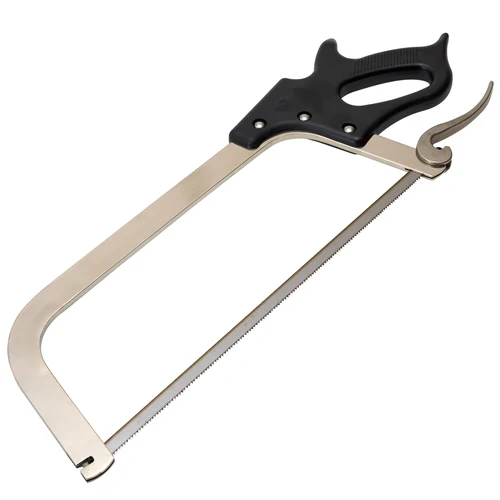
LEM 16-Inch Meat Saw Review: Clean Cuts Through Bone
As an Amazon Associate, this website earns from qualifying purchases.
The LEM 16-inch meat saw is a manual bone saw built to break large pieces of meat into smaller cuts. LEM says the blade cuts through bone, sinew and muscle, and the saw pairs a heavy-duty nickel-plated frame with an ergonomic handle. A cam-lock lever holds the blade tight and releases it for changes, and the saw ships with a half-inch carbon steel blade with 10 teeth per inch. It is the kind of tool you use deliberately, with pressure on the forward stroke and a relaxed return, rather than forcing the blade through the work.
Key Takeaways
- The 16-inch frame is sized for home butchering and breaking down large cuts.
- LEM lists the blade as able to cut through bone, sinew and muscle.
- The nickel-plated frame is paired with an ergonomic handle and a cam-lock blade tightening lever.
- A half-inch carbon steel blade with 10 teeth per inch is included.
- LEM's own guidance is to apply pressure on the forward stroke only and keep to about one stroke per second.
Built for Home Butchering
The saw is aimed at the job a knife cannot do: getting through bone without tearing the surrounding meat. LEM describes the frame as heavy duty and nickel plated, with a stainless-steel high-speed tool blade for cut strength. The ergonomic handle is there to keep the saw comfortable through a long session, and the cam-lock lever lets you tension the blade before a cut and slacken it when the blade needs changing.
Because it is a hand saw, the pace is yours. LEM's instructions are specific about technique: pressure goes on the forward cutting stroke, the return stroke is relaxed, and about one stroke per second is the top speed. The blade does the work, not the operator.
What the Saw Does Well
The design keeps the parts you touch simple. There is one lever for blade tension, one handle to grip, and a frame that LEM says resists corrosion. Replacement blades are sold separately in two widths, half-inch and one-inch, both with 10 teeth per inch, so the saw can be kept running rather than replaced when a blade wears out.
LEM also gives a practical rule for blade choice: pick a teeth count so at least two teeth stay in contact with the work at all times. That avoids a single tooth catching and tearing off, which is the usual way a thin blade fails.
Detailed Features
Here is what LEM lists for the saw:
- Frame: heavy-duty nickel-plated frame with a plastic handle.
- Blade: half-inch wide carbon steel blade, 10 teeth per inch, included.
- Blade changes: large cam-lock blade tightening lever.
- Sizes: the meat hand saw line comes in 16-inch, 22-inch and 25-inch frames.
- Care: disassemble the saw, wash the blade, wipe the frame with soapy water, rinse and hand dry.
LEM is direct about care: do not soak the saw, and spray the frame with silicone spray or a food-safe equipment lubricant after cleaning.
Advantages and Drawbacks Summary
The advantages are the ones a manual saw should have. There is no motor to fail, the blade tension is adjustable by hand, and the blade is a consumable you can replace. The frame is described as nickel plated for durability, and the handle is shaped for a long cutting session.
The trade-offs are equally plain. A hand saw depends on your stroke and your patience, and LEM's own instructions warn that too much pressure on the ends of the saw will flex the blade and shorten its life. The blade also has to be cared for properly: no soaking, and a dry and lubricated frame after washing.
Ideal for Game Processing
For hunters and home butchers working through large cuts, the 16-inch frame is the compact end of LEM's line. It suits a bench or a table where a longer saw would be awkward, and the same cam-lock and handle design carries across the 22-inch and 25-inch versions if you need more reach.
The technique LEM describes is the one that matters in the field as much as at home: steady strokes, pressure forward, and a fresh cut rather than forcing a worn blade back into an old kerf.
Frequently Asked Questions
What blade comes with the saw?
LEM includes one half-inch wide carbon steel blade with 10 teeth per inch. Replacement blades are sold separately in half-inch and one-inch widths, both with 10 teeth per inch.
How do I change the blade?
The saw uses a large cam-lock blade tightening lever. Release the lever to take the tension off the blade, fit the replacement, then lock the lever to tension it again.
How should I cut with a hand meat saw?
LEM's guidance is to apply pressure on the forward cutting stroke only and relax on the return. About one stroke per second is the top speed, and forcing the saw flexes the blade.
Can I put a new blade into an existing cut?
LEM advises against it. A worn blade makes a narrower cut than a new one, so a new blade placed in an old cut loses its set in the first few strokes. Flip the work and start a new cut instead.
How do I clean the saw?
Disassemble the saw and separate the blade from the frame. Wash the blade, wipe the frame with soapy water, rinse and hand dry. Do not soak it, and apply silicone spray or a food-safe equipment lubricant afterwards.