
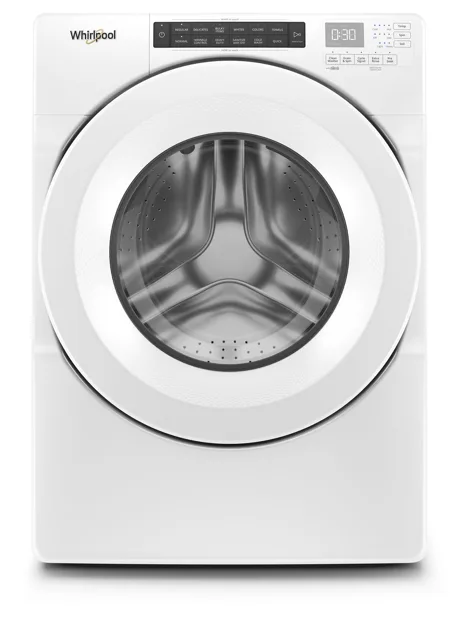
Whirlpool WFW560CHW Front Load Washer Review
We may earn a commission from some links on this page.
The Whirlpool WFW560CHW is a front-load washer with a 4.3 cubic foot drum, sold in white with a closet-depth cabinet and intuitive controls. It is the machine you look at when the laundry space is narrow but you still want the drum size of a normal household washer. This review covers what the model is, how a front-load washer of this size behaves day to day, and what to check before you buy it.
Key Takeaways
- The WFW560CHW has a 4.3 cubic foot drum, a normal family size rather than a compact one.
- Its closet-depth cabinet is built to sit in a shallower alcove than a standard-depth washer.
- Front-load tumbling washes clothes through a shallow pool of water instead of soaking them in a full drum.
- The front panel carries the everyday controls, with the door in the front for loading and unloading.
- A front-loader needs high-efficiency detergent and a wiped door seal to stay fresh.
What 4.3 Cubic Feet Means in Practice
A 4.3 cubic foot drum is the middle of the front-load range. It takes a normal family wash, a set of towels or a week of clothes without splitting the load in two. The size also decides what will not fit: a very bulky item such as a large comforter is the first thing to outgrow a drum this size, and those loads are better taken to a launderette or washed in a larger machine.
Because the drum turns the clothes rather than dragging them around a central agitator, there is no post in the middle to tangle sleeves and sheets. That is the main practical difference between a front-loader and a top-loader of the same capacity, and it is the reason people with delicate fabrics tend to prefer the front-load layout.
Why a Closet-Depth Cabinet Matters
Depth is the measurement that catches people out. A standard front-load washer is deep enough that the machine, its hoses and its door can crowd a narrow closet, a hallway cupboard or a run of kitchen-style units. A closet-depth cabinet is built to sit closer to flush, so the laundry door can close and the washer does not stick out into the walkway.
That shallower cabinet is the whole reason to choose this model over a deeper machine with a similar drum. Before ordering, measure the depth of the space with the door open as well as closed, and leave room at the back for the inlet and drain hoses. Whirlpool lists the model as closet depth, but the final check is your own tape measure against the alcove the washer has to live in.
Front-Load Washing, Day to Day
A front-load washer fills to a shallow level and tumbles the clothes through the water. It uses less water than a top-loader that submerges the whole load, and the tumbling action is what does the cleaning. That is why a front-loader needs a low-sudsing high-efficiency detergent: an ordinary detergent foams up in the small amount of water and the extra suds do not rinse away properly.
The door seal is the other part that needs a habit. Water sits in the fold of the rubber gasket after a wash, so wiping it dry and leaving the door ajar between loads keeps mould from starting. The detergent drawer benefits from the same treatment. None of this is difficult, but it is the maintenance a front-loader asks for that a top-loader does not.
Detailed Features
The feature list is short on purpose. The drum, the closet-depth cabinet and the controls on the front panel are the points this model is sold on, and they are the things you will use every day.
| Feature | Benefit | Consideration |
|---|---|---|
| 4.3 cu. ft. drum | Handles a normal family load | Very bulky items still outgrow it |
| Closet-depth cabinet | Sits in a shallower alcove | Measure depth and door swing first |
| Intuitive controls | Everyday settings on the front panel | Check the cycle list in the manual |
| Front-load door | Easy to see and reach the load | Leave it ajar so the seal dries |
| White finish | Matches a standard white laundry pair | Wipe the panel to keep it clean |
Read the manual for the exact cycle list before you buy, because the model name tells you the layout, not the programme names.
Advantages and Disadvantages Overview
The case for the WFW560CHW is space and drum size together: a 4.3 cubic foot front-loader that does not need a full-depth alcove. The case against it is the maintenance and detergent routine every front-loader shares, plus the fact that a bigger drum is available if the room allows it.
| Advantages | Disadvantages |
|---|---|
| 4.3 cu. ft. drum in a shallower cabinet | Needs high-efficiency detergent |
| No agitator to tangle or wear clothes | Door seal needs wiping after washes |
| Plain front-panel controls | Large comforters are a tight fit |
| White finish suits a standard laundry pair | Loading low means bending, unless it sits on a pedestal |
Who It Suits
This washer suits a household with a laundry closet, a narrow utility run or a hallway cupboard, where a standard-depth machine would block the way. It also suits anyone replacing an old front-loader who wants the same layout and a drum that takes a family wash. It is less suited to a household that regularly washes king-size bedding, and less suited to anyone who wants the largest drum the space can hold.
If the space is tighter than you thought, there are two routes. A pedestal raises the washer so the drum is at hip height and gives back the bending, and a stacked tower puts a smaller washer and a dryer into one narrow footprint.
Frequently Asked Questions
Does the Whirlpool WFW560CHW Need a Special Detergent?
It needs a high-efficiency, low-sudsing detergent, the kind sold as HE detergent. A front-loader uses a shallow pool of water, and an ordinary detergent foams too much for that little water, which leaves residue on the clothes and in the drum.
Will It Fit in a Laundry Closet?
The closet-depth cabinet is made for that, but measure the alcove before ordering: the closed depth, the width, the height and the swing of the door. Leave clearance at the back for the hoses and at the sides so the machine does not rub against the frame.
Can It Sit on a Pedestal?
Whirlpool sells a 12-inch pedestal for its front-load washers and dryers, shown above. Check that the pedestal matches your model before buying, and remember the pedestal adds height, so measure the closet opening again with it in place.
Why Should the Door Be Left Open?
Water stays in the fold of the rubber door seal after a wash. Leaving the door ajar lets the seal and the drum dry, which is the simplest way to stop mould and the musty smell that comes with it.
Is 4.3 Cubic Feet Enough for a Family?
For normal clothes, towels and bedding it is enough for a family wash. The exception is very bulky items such as a large comforter, which need more room than a 4.3 cubic foot drum gives.