

Imagine transforming your home by seamlessly merging your kitchen and living room into one cohesive space. By using strategic layout techniques, you can create a functional and aesthetically pleasing environment. Consider how a multi-purpose island and unified color palette can enhance flow and continuity. With attention to detail and smart design choices, this transformation offers the perfect blend of style and practicality. Curious about how to achieve this seamless integration?
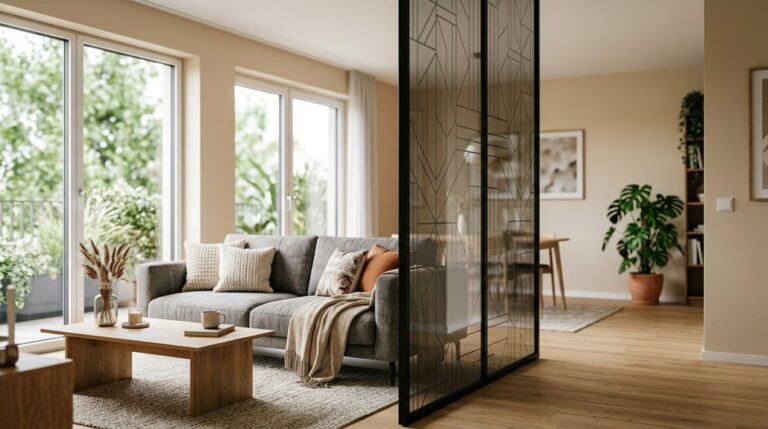
1. Optimize Furniture Placement for Seamless Flow

When optimizing furniture placement for seamless flow in your open-plan kitchen and living room, consider the power of strategic zoning. Position your sofa with its back to the kitchen to define living and cooking areas distinctly—this visual boundary enhances circulation.
Use the kitchen island or peninsula as a bridging anchor, encouraging interaction with seating on the living side. Ensure a 36–42 inch clear walkway behind seats for unobstructed traffic flow.
Rugs and furniture groupings help delineate zones; an 8×10 or larger rug under the sofa and coffee table anchors the living space, keeping seating focused away from kitchen activity. Low-height storage like a backless bookcase or bench behind the sofa divides space subtly, maintaining light flow and openness.
2. Use Cohesive Color Schemes and Materials

After optimizing furniture placement for a seamless flow, using cohesive color schemes and materials takes your open-plan kitchen and living room to the next level.
Start by selecting a single flooring material like 3/4″ engineered oak planks to eliminate visual breaks, enhancing the perception of space by 10-15%.
Coordinate at least two repeat tones—one dominant neutral and an accent wood or terracotta—across cabinetry, upholstery, and trim for cohesion.
Align major surface finishes within the same color temperature to keep the eye moving smoothly.
Unify metal finishes, such as cabinet hardware and lighting, to make small details feel deliberate.
Limit bold patterns to one zone, using textured solids elsewhere to maintain balance.
- Use single flooring material
- Coordinate repeat tones
- Align surface finishes
- Unify metal finishes
- Limit bold patterns
3. Implement Strategic Lighting to Define Zones

Illuminate your space with strategic lighting to artfully define distinct zones within your open-plan kitchen and living area. Use layered lighting to enhance your kitchen and living room combo. Ambient lighting at 300–400 lux sets a cozy backdrop, while task lighting at 500–700 lux focuses on prep and dining areas. Accent lighting at 100–200 lux adds depth. Install pendants or a chandelier over the dining table to anchor the eating zone. Dim lights to 150–200 lux for a relaxed mood. Apply cooler 3000–3500K for kitchen tasks and warmer 2700–3000K for living/dining to create separation.
| Lighting Type | Lux Level | Application Area |
|---|---|---|
| Ambient | 300–400 | General space |
| Task | 500–700 | Prep and dining |
| Accent | 100–200 | Zone delineation |
| Pathway | 200–300K candela | Circulation and safety |
| Color Temp | 3000–3500K (cool) / 2700–3000K (warm) | Kitchen tasks / Living & dining |
Strategically illuminate your kitchen and living room combo for stunning functionality and aesthetics.
4. Create Functional Multi-Purpose Islands

A well-designed multi-purpose island can be the crown jewel of your kitchen and living room ensemble.
To achieve this, design the island at least 42–48 inches deep for integrated prep and casual dining, ensuring a 24–30 inch workspace with a 15–18 inch overhang for seating. Incorporate task zones to streamline activities and minimize cross-traffic:
- Prep Zone: Drawer storage, trash pull-out.
- Cleanup Zone: Undermount sink, dishwasher adjacency.
- Service Zone: Bar fridge, open shelving.
Maximize utility by including deep drawers and a pantry or appliance garage to replace wall cabinets, keeping surfaces clutter-free.
Opt for durable, low-maintenance surfaces like quartz or porcelain, and integrate power options with outlets and USB ports for seamless functionality throughout the kitchen living room.
5. Enhance Circulation With Clear Pathways

When designing your kitchen and living room, ensuring clear pathways is essential for both aesthetics and functionality.
To seamlessly merge your living room and kitchen together, maintain at least 36 inches of circulation space between elements like sofas and kitchen counters. This allows two people to pass comfortably.
Align primary pathways—entry to kitchen to living room—without furniture corners intruding, minimizing crossings that cause bumping and visual clutter.
Be mindful of door swings and appliance clearances, leaving 30–36 inches in front of ovens and refrigerators to keep tasks unhindered.
Define the living zone using the back of a sofa or a half-wall, preserving a 30–36 inch passage. Rugs and lighting can signal shifts, maintaining sightlines and guiding movement naturally.
6. Integrate Storage Solutions for Visual Continuity

While designing your open-plan kitchen and living room, consider integrating storage solutions that seamlessly blend these two spaces.
Install continuous low-profile cabinetry or open shelving that extends from the kitchen island into the living area.
This creates a visual tie between zones while providing convenient surface and concealed storage.
- Use built-ins with concealed appliance garages and deep drawers near the island for a clutter-free look.
- Extend the same finish or wood veneer across kitchen and living room storage to enhance visual continuity.
- Design multifunctional pieces like a bench or banquette with under-seat storage.
- Implement perimeter storage strategies such as floating shelves or bookcases to define zones without blocking light.
- Keep display depths shallow to maintain airflow and sightlines.
Optimize your space for a harmonious, open space living room and kitchen experience.